

Central Imaging & Flow Cytometry Facility - Bangalore Microscopy Course
Bangalore Microscopy Course
About
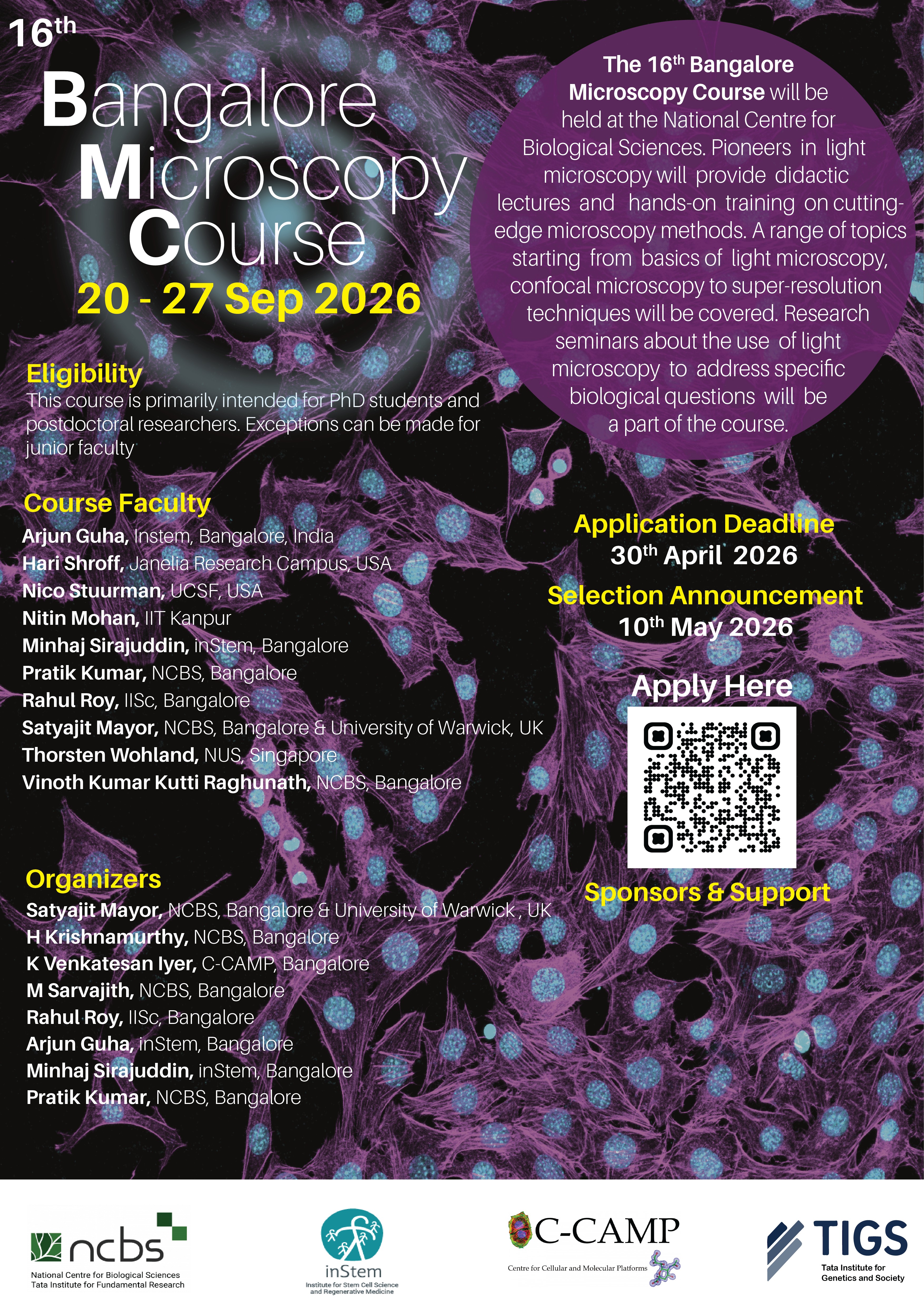
The 16th Bangalore Microscopy Course (BMC) will be organized at the National Centre for Biological Sciences (NCBS), Bangalore, India during 20th - 27th September 2026.
This course is jointly organized by NCBS, Institute for Stem Cell Biology and Regenerative Medicine (inStem), Centre for Cellular and Molecular Platforms (C-CAMP) and Tata Institute for Genetics & Society (TIGS).
Taught by world leaders in biological microscopy, the course offers comprehensive didactic and hands-on training in state-of-the-art optical microscopy techniques. Topics will span from basic microscopy to super-resolution imaging. Research seminars detailing applications of light microscopy to address specific biological questions will also be part of the program. Lectures will be complemented by hands-on training in a dedicated teaching laboratory equipped with many state-of-the-art microscopes.
Over the years, the Bangalore Microscopy Course has become a key meeting point for the Indian and international imaging community, serving as a platform where academia and industry interact, new technologies are introduced and future microscopy leaders are trained.
Organisers
Course Overview
24 participants will be selected through a competitive selection process. The couse is deisgned for small number to ensure every participant individually gets sufficient time on various imaging stations during the hands-on training sessions.
International applications will be entertained from across the globe. Previous courses have had participants from Argentina, China, Singapore, Australia, USA, UK, Russia, Japan, Spain, South Africa, Germany, Switzerland, France, Nigeria, Sweden, Portugal, Poland, Norway, Qatar, Hungary and Pakistan.
The course will be intense and will require full-time participation from morning till evening. Lectures will be combined with practical demonstrations and discussions with teachers. The course will cover many aspects of modern biological microscopy including microscope optics, associated hardware, fluorophores and sample preparation techniques. Participants can bring their own samples to image using the systems available at the course. Designated 'free time on microscopes' will be available practically every day of the course where the participants can explore a particular imaging system and image their samples.
A set of student independent projects will be provided for the final part of the course. An expert faculty/industry scientist will guide each of these projects. Participants can also design their own projects based on the instruments/techniques available at the course. In such case they will have to bring their own samples and reagents.
All major microscope companies and microscope hardware/software providers are attending and providing additional equipment and support to this course. The participants will have the opportunity to interact with technical experts from these companies as well as receive demonstrations of high-end equipment they bring as exhibits. Some of these equipment will also be included as part of the course.
Travel
Participants are responsible for arranging and covering their cost of travel to NCBS, Bengaluru.
Application procedure
Apply by scanning the QR code and upload the following documents:
1. Curriculum Vitae
2. A short write-up on how Bangalore Microscopy Course will help you in your research
3. At least one letter of recommendation preferably from your supervisor supporting your application
Course schedule
| Sl. No. | Name | Institution |
| 1 | Aniket Rajendra Navale | Indian Institute of Science, Bengaluru |
| 2 | Anoushka Chatterji | Tata Institute of Fundamental Research, Mumbai. |
| 3 | Anshita Srivastava | Advanced Centre for Treatment Research and Education in Cancer |
| 4 | Anupam Bhardwaj | Indian Institute of Technology, Guwahati |
| 5 | Ayush Khandelwal | Manipal School of Life Sciences, MAHE, Manipal, Karnataka |
| 6 | Damini | Regional Centre for Biotechnology, Faridabad |
| 7 | Dibyajyoti Ghosh | Indian Institute of Technology, Kharagpur |
| 8 | Dipanjana Banerjee | Tata Institute of Fundamental Research, Mumbai |
| 9 | Harshil Umrawala | Aston Institute for Membrane Excellence, Aston University |
| 10 | Heena Bholaram Choudhary | Birla Institute of Technology and Science, Pilani Hyderabad campus |
| 11 | Jyotsna Sinha | Jawaharlal Nehru University, Delhi |
| 12 | Kuppili Gowhith | DBT BRIC- National Centre for Cell Science, Pune |
| 13 | M.Adhavan Manoharan | Vellore Institute of Technology-vellore campus |
| 14 | Neha Singh | ACTREC-TMC |
| 15 | Nilaratna Das | National Institute of Science Education and Research |
| 16 | Ritika Dewra | Indian Institute of Science Education and Research, Pune |
| 17 | Ronit Jain | National Institute of Immunology |
| 18 | Rupayan Rakshit. | Indian Institute of Technology, kharagpur. |
| 19 | S Manasa Veena | Indian Institute of Science Bengaluru |
| 20 | Sanidhya Nilesh Dude | ACTREC-TMC |
| 21 | Shashikant Gawai | National Institute of Animal Biotechnology, Hyderabad |
| 22 | Skanda Athreya Dutt | Tata Institute of Fundamental Research, Hyderabad |
| 23 | Srashti Birla | Indian Institute of Technology, Madras |
| 24 | Sumita Panda | Indian Institute of Technology, Gandhinagar |
| 25 | Tuneer Ranjan Mallick | BRIC-National Institute of Biomedical Genomics, Kalyani |
| 26 | Urbi Ghosh | National Institute of Science Education and Research, Bhubaneswar |