


Archives at NCBS : Events - Between the Concrete and the Abstract: Computational Work in South Indian History
Archives at NCBS | Public Lecture Series
73rd edition
Talks framed around explorations in and around archives. Discussions by artists, archivists, academics, lawyers, teachers, journalists and others.
Between the Concrete and the Abstract: Computational Work in South Indian History
Senthil Babu D.
Fri, Feb 20, 2026. 5 PM
Haapus (LH-1), NCBS
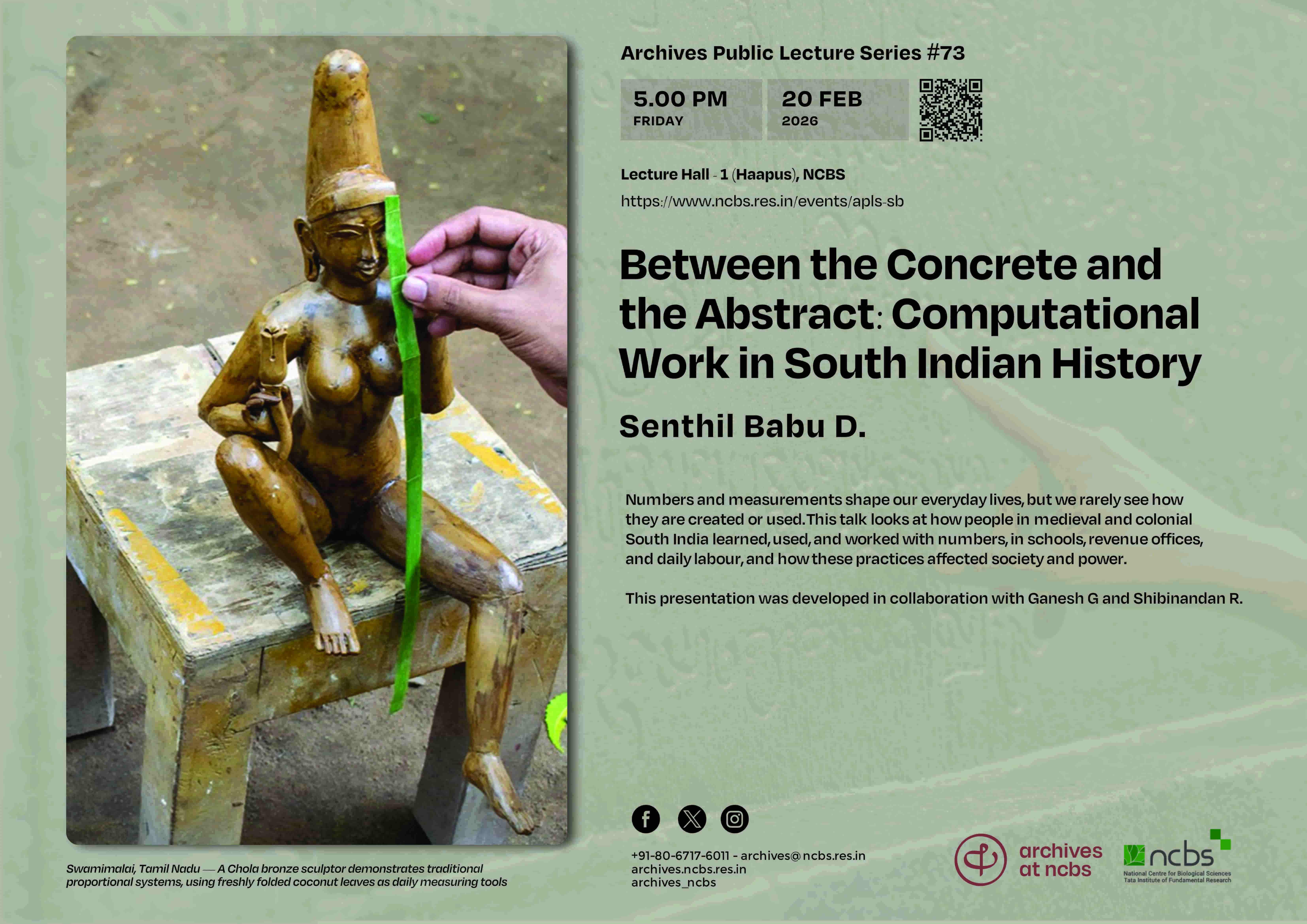
Abstract:
Measures and metrics of different kinds influence our contemporary lives. Calculations with these metrics are are becoming not so transparent. Values that get determined through measure and calculation present themselves through different kinds of computational work. What is real gets folded into the notional, propelling registers of abstraction, delegated to occupations and jobs, which change and influence the classrooms and universities. But is it all happening only now? How could histories of computational work inform us so that we can subject our compliance to metrics with careful scrutiny?
In this talk, we will take examples from medieval and the colonial era to guide us. The practice of recollective memory remained central to the cultivation of learning numbers in the elementary learning institutions of south India during the early modern period, and even earlier. The practice, facilitated a movement between the concrete and the abstract, transforming the measure into a number so that further processes of abstraction, in the context of calculation, becomes possible. We will discuss how computational work in the occupation of the revenue accountant in the medieval, early modern and the colonial periods involved the constant movement between the real and the notional, but with political consequences for the people. The practices of learning arithmetic at school constituted a social process through which measures and numbers became central to computations, in the class room, at the work place and in the threshing floors.
We will demonstrate this movement by showcasing our initiative to build an archive of mathematical practices @ echoes.ifpindia.org. This is also a sincere invitation to seek feedback and participation in the making of this archive, where we want to consider texts and objects as material records of practices, in ways that real practitioners and their everyday work become central to reconstruct a social history of mathematical practices in India.
Bio:
Senthil Babu D., is a historian of mathematics based at the French Institute of Pondicherry, in south India, where he is involved in studies concerning Nature, Knowledge and Labour [https://ifpindia.org/research/social-sciences/knowledge]. His research in the history of science and mathematics is focused on knowledge practices in political economies to understand the relationship between abstraction and alienation in different cultures. The programme in the Social History of mathematical practices subjects computational work to historical scrutiny, through inquiries into texts, practice and practitioners. Practices of measure, calculation and value making, remain central concerns for such a programme. A historical atlas of metrology and an archive of computational practices in south India are part of this initiative: echoes.ifpindia.org. He completed his PhD from the Centre for Historial Studies, Jawaharlala Nehru University in New Delhi. His book, Mathematics and Society: Numbers and Measures in early modern South India, was published by Oxford University Press in 2022. He is a member of the editorial board of the series, Verum Factum: Studies in Political Epistemology [https://verumfactum.it/]. He recently published with others, an edited volume on Science and Praxis: Historical Cases of Political Epistemology, Series Intersections, Brill, 2025. He is a member of the Politically Mathematics Collective in India [https://www.politicallymath.in/]