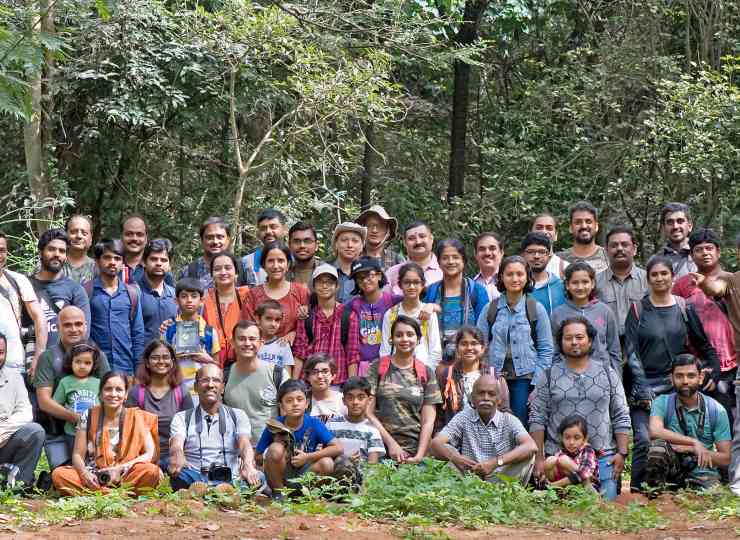





This year, the 7th BMC meeting was held in NCBS from 20th to 27th September, 2015. Microscopy is a technique that is used in most aspects of biological research. The field of microscopy is a dynamic one with new technology and techniques being developed for a vast array of uses. The Bangalore Microscopy course is an intense, week-long course designed to cover the many aspects of microscopy and explore new developments in this field for their potential application in research.
A brief history
A little more than 7 years ago, Ron Vale (University of California) and Satyajit Mayor (National Centre for Biological Sciences (NCBS)) envisioned a unique microscopy course for Asian researchers. The idea was to instil in the participants of this course, an understanding and appreciation for microscopy as a tool in scientific research. They were supported in this endeavour by Nico Sturman and H. Krishnamurthy, two highly capable and experienced scientists in the art of conducting hands-on microscopy courses. And so, the Bangalore Microscopy Course was born - its first meeting held in NCBS in the year 2009.
The evolution of the BMC
"In the first meeting, there was just a 4-member team from NCBS handling almost every aspect of the course", says Anupama Ambika, who has been involved with every BMC meeting since its inception. Over the years, the course has evolved in different ways to explore avenues that allowed attendees to understand microscopes. Over the years, the BMC has developed into a platform, not only for Asian researchers, but also for an international community of scientists to appreciate the versatility of microscopy techniques. In its latest spurt of growth, the BMC organisers included a cohort of students from NCBS, who were chosen as teaching assistants to advance their experience in microscopy by instructing others.
The course also features group discussions and projects; ideas that were incorporated in the second BMC (in 2010) and the third BMC (in 2012) respectively. The group discussions involve a single faculty or teacher interacting with batches of students to answer queries regarding his/her field of microscopy expertise. The projects are of short durations - barely 48 hours long - but concentrated efforts by groups of participants to answer a biological problem by using all the available microscopes, microscopy techniques and expertise offered by NCBS and visiting faculty. Moreover, the course encourages participants to bring in their own samples to work on for their short projects.
What's new this year?
Every year, the BMC starts its program with a session revising the basics of optics. This year, there was a difference - this year, basic optics became a much more interactive experience. Instead of simply discussing the principles of optics, the lab course kick-started the program with a hands-on microscope building session. Participants were divided into groups and given the components of a microscope such as lens, mirrors, filters and condensers, along with a schematic on how to put them together to get a working microscope. Students were encouraged to play around with lenses and arrangements to get a better feel for how the pieces fit and worked together in the finished product - a functional microscope. "It was like a microscope Lego! You could arrange things any which way, just to see what happened", says Manoj Mathews, one of the organisers and teachers at the BMC.